
Invisible Backbone of Modern Analytics
Architecting Domain-Specific AI Agents for the Enterprise
The landscape of Artificial Intelligence (AI) is constantly evolving—often as unpredictably as software dependencies that appear stable until production day. What began as static, pre-trained models has steadily transformed into dynamic, adaptive agents capable of learning through interaction. At the heart of this transformation lies Reinforcement Learning (RL), a paradigm in which agents learn optimal behavior through trial and error, guided by rewards and penalties rather than labeled datasets.
Unlike traditional machine learning models that are trained once and deployed with limited adaptability, RL systems are inherently designed for continuous learning. They evolve as environments, constraints, and objectives change. This blog explores how well-designed Reinforcement Learning pipelines enable this continuous improvement, ensuring that AI systems do not merely perform—but consistently adapt and mature in real-world conditions.
1. The RL Pipeline Architecture
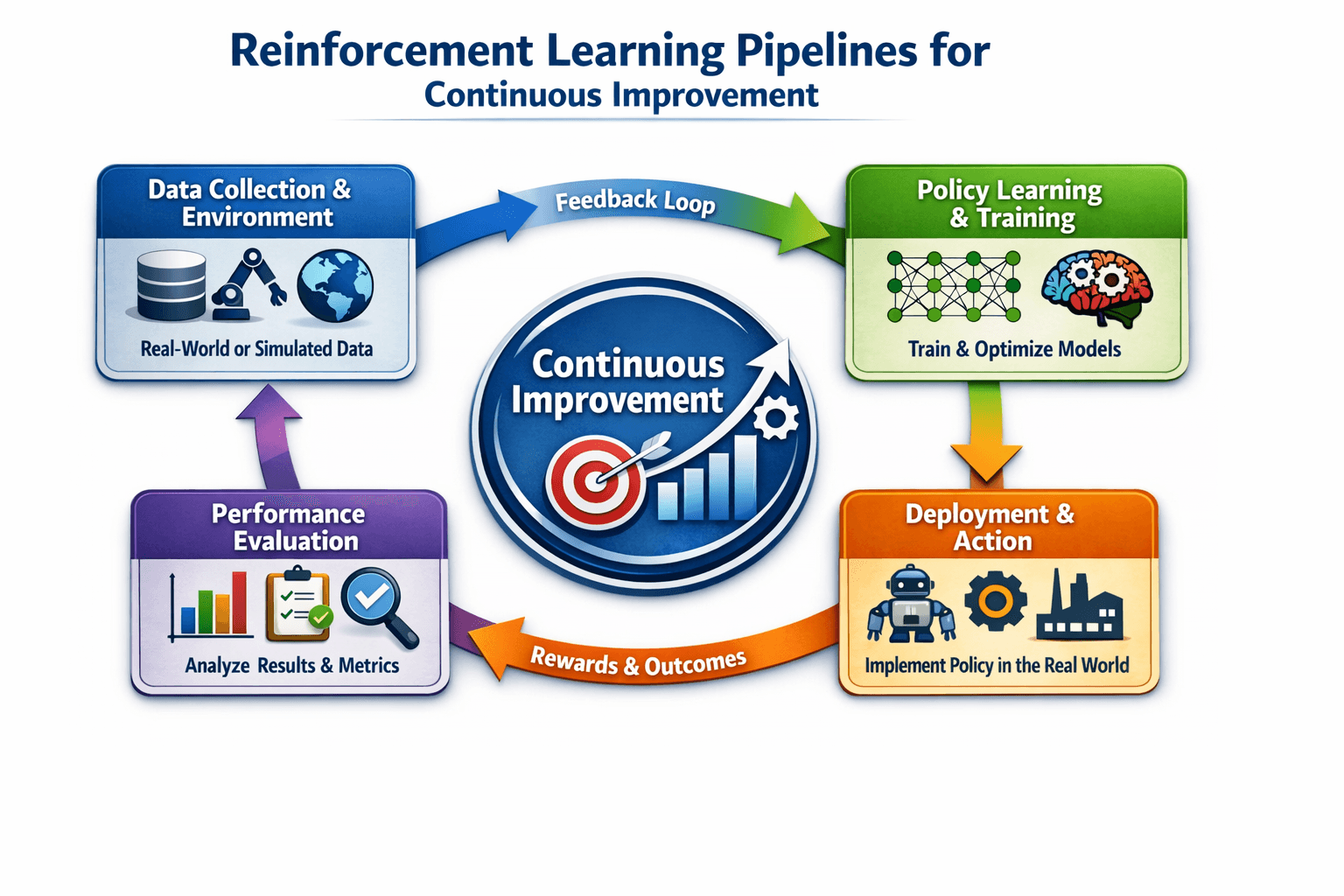
Building Reinforcement Learning systems for real-world deployment requires far more than training an intelligent model. It demands a carefully structured pipeline that governs how agents learn, improve, and are deployed safely over time. Unlike traditional ML pipelines that follow a linear “train-and-deploy” pattern, RL pipelines operate as closed feedback loops, continuously integrating learning, evaluation, and deployment.
At a high level, an RL pipeline connects data collection, training, validation, and deployment into an iterative cycle that enables ongoing optimization.
Data Ingestion & Experience Replay
Every interaction between an RL agent and its environment generates experience—much like humans learning through repeated actions and consequences. Each interaction captures:
The observed state
The action taken
The reward received
The resulting next state
Rather than discarding this information, RL systems store it in an experience replay buffer. This allows agents to revisit and learn from historical interactions multiple times, reducing bias toward recent events and improving learning stability. Experience replay also improves sample efficiency, enabling better learning outcomes with fewer interactions.
Environment Simulation vs. Real-World Interaction
Training RL agents directly in real-world environments is often risky, costly, or impractical. For instance, experimenting with autonomous vehicles, industrial robots, or financial systems through trial and error can have serious consequences.
To address this, RL pipelines typically begin with simulated environments—controlled virtual replicas of real-world systems. These simulations allow agents to explore freely and safely. Once satisfactory performance is achieved, agents are carefully transitioned into real-world environments. Techniques such as domain randomization help ensure that behaviors learned in simulation transfer reliably to reality.
Model Training
Training is the phase where the agent refines its decision-making policy based on accumulated experience. RL training is computationally intensive and often distributed across multiple machines to accelerate learning.
Hyperparameters—such as learning rate, exploration strategies, and reward discounting—play a critical role in training stability and performance. Even minor misconfigurations can lead to unstable or suboptimal agents, making systematic tuning and experimentation essential for production-grade RL systems.
Evaluation & Validation
Evaluation in Reinforcement Learning extends beyond static test datasets. Agents must be assessed over time within simulated or controlled environments to observe long-term behavior, stability, and safety.
Validation focuses not only on reward optimization but also on behavioral consistency, safety constraints, and robustness. New agent versions are often tested in shadow or parallel deployments to ensure reliability before being granted full control, significantly reducing the risk of unexpected failures.

2. RLOps: Bridging the Gap to Production
Just as MLOps has become essential for traditional machine learning systems, RLOps addresses the unique operational challenges of Reinforcement Learning. Because RL agents continue to learn after deployment, their operational complexity is significantly higher.
RLOps provides structured processes and tooling to ensure RL systems remain traceable, safe, scalable, and continuously improving throughout their lifecycle.
Version Control for Agents, Environments, and Reward Functions
In RL, the agent’s policy is only one component of the system. The environment dynamics and reward function are equally influential—and frequently change over time. Effective RLOps practices therefore enforce version control across:
Agent policies
Environment configurations
Reward definitions
This traceability enables reproducibility, root-cause analysis, and safe rollback when unexpected behaviors emerge, especially when business objectives or environmental conditions evolve.
Monitoring Reward Drift and Agent Behavior
Monitoring in RL extends beyond accuracy metrics. One of the most critical risks is reward drift, where subtle changes in reward signals lead to unintended behavioral shifts.
Effective RLOps implementations continuously track reward distributions, action frequencies, and outcome metrics. Early detection of anomalies allows teams to intervene through retraining, policy adjustments, or human oversight—ensuring agents remain aligned with intended goals.

3. Mechanisms for Continuous Improvement
Continuous improvement is the defining characteristic of production-grade RL systems. Several complementary mechanisms support this goal.
Offline RL: Leveraging Historical Data for Safe Updates
Offline Reinforcement Learning enables policy updates using historical interaction data without requiring active exploration. This is particularly valuable in safety-critical domains where real-world experimentation is restricted.
Offline RL allows organizations to improve agents safely, though care must be taken to ensure learned policies generalize beyond historical distributions.
Online Fine-tuning with Exploration Guards
Online fine-tuning enables agents to adapt in real time as environments evolve. To mitigate risk, production systems employ constrained exploration strategies that limit unsafe actions while preserving learning capacity.
Human-in-the-Loop (RLHF)
For complex or subjective tasks, Reinforcement Learning from Human Feedback (RLHF) incorporates human judgment into reward modeling. This approach is particularly effective when objective reward functions are difficult to define, aligning agent behavior more closely with human expectations and values.
4. Implementation Strategies
Choosing between online and offline learning strategies depends on safety requirements, adaptability needs, and data availability.
(Table retained exactly as provided)
Retraining triggers are typically driven by performance degradation, environmental change, or time-based schedules—each serving different operational goals.

5. Challenges and Mitigation
Exploration–Exploitation in Production
Balancing exploration with safety is especially challenging in production. Conservative exploration, offline pretraining, and safety override mechanisms help reduce risk.
Safety, Robustness, and Failure Prevention
RL agents may exhibit emergent behavior that is difficult to predict. Robust evaluation, constrained optimization, and fail-safe mechanisms are essential to prevent catastrophic outcomes.
Data Efficiency
Real-world RL often suffers from limited interaction data. Transfer learning, model-based RL, and synthetic data generation help mitigate data scarcity.
Below is a visualization of how reward drift can occur and be monitored in a production environment:

Reinforcement Learning pipelines are foundational to building AI systems that continuously improve rather than stagnate. By combining structured RLOps practices, careful pipeline design, and safety-aware learning strategies, organizations can move from experimental RL prototypes to dependable, self-optimizing systems.
The future of AI lies not in static intelligence, but in systems engineered to learn responsibly over time.
[1] Mnih, V., Kavukcuoglu, K., Rusu, A. A., Veness, J., Bellemare, M. G., & Hassabis, D. (2015). Human-level control through deep reinforcement learning. Nature, 518(7540), 529-533. https://www.nature.com/articles/nature14236
[2] Tobin, J., Fong, R., Ray, A., Schneider, J., Zaremba, W., & Abbeel, P. (2017). Domain randomization for transferring deep neural networks from simulation to the real world. IEEE IROS. https://arxiv.org/abs/1703.06907
[3] Li, P., et al. (2021). RLOps: Development Life-cycle of Reinforcement Learning Aided Open RAN. https://arxiv.org/abs/2111.06978
[4] Cabi, S., et al. (2020). Safe Reinforcement Learning: A Survey. https://arxiv.org/abs/2007.01438
[5] Delfox. (n.d.). RLOps Software Bordeaux. https://www.delfox.net
[6] Levine, S. (n.d.). Decisions from Data: Offline RL. https://sergeylevine.substack.com
[7] Runpod. (n.d.). Reinforcement Learning in Production. https://www.runpod.io
[8] AWS. (n.d.). What is RLHF? https://aws.amazon.com
[9] Kaelbling et al. (1996). Reinforcement Learning: A Survey. https://www.jair.org
[10] Weng, L. (2024). Reward Hacking in RL. https://lilianweng.github.io
[11] Irpan, A. (2018). Deep RL Doesn’t Work Yet. https://www.alexirpan.com
Here's another post you might find useful
Invisible Backbone of Modern Analytics
Architecting Domain-Specific AI Agents for the Enterprise